
SOC 1 for Fintech
We deliver SOC 1 attestations that bridge the gap between finance and information technology. We leverage financial statement audit experience alongside deep system processing integrity knowledge.
- Auditors with an in-depth understanding of financial statement audit principles
- Professionals versed in IT security and data processing integrity fundamentals
- Auditors who coordinate directly with user auditors when needed






SOC 1 Audits Performed Against Real-Life Risk Principles
A SOC 1 report is an independent examination of controls at a service organization that impact user entities’ financial reporting. It’s not optional when your clients’ auditors need reliance.

SOC 1 reports build trust with your customers, so they can be confident that the financial data processed in your system is complete and accurate.
Auditors who speak about information security, processing integrity fundamentals, financial statement principles, and most importantly, perform risk-based audits.
Use of our audit platform to dynamically map between controls, objectives, and evidence items.
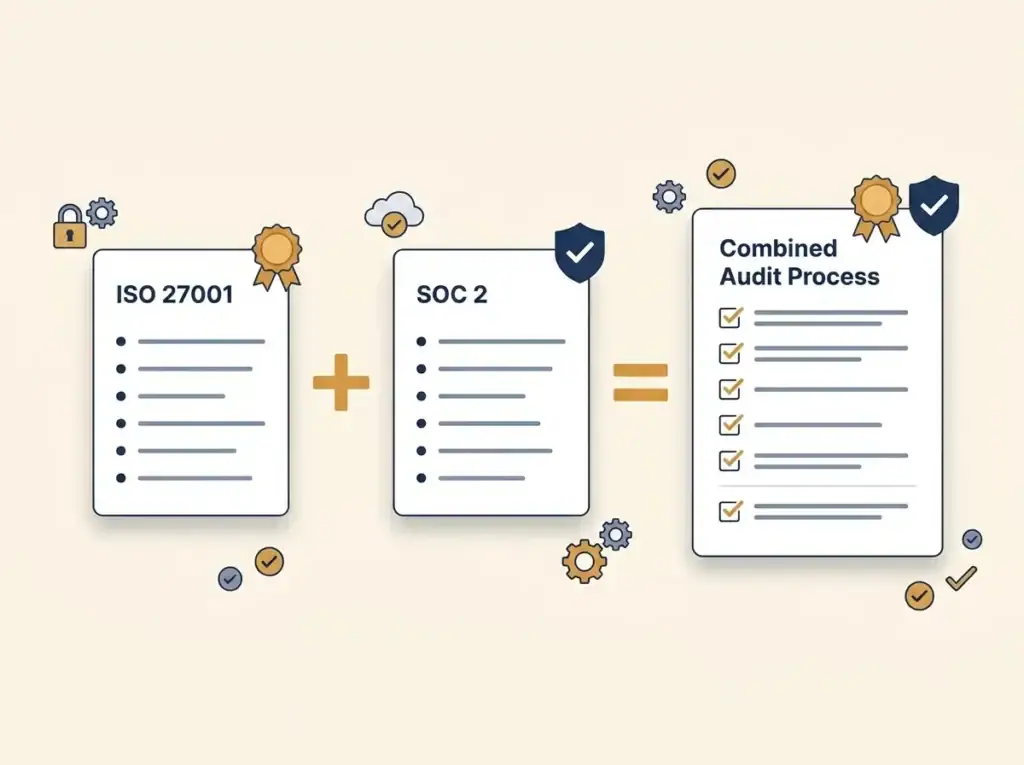
Support for cross-framework audits easily combines SOC 1 and SOC 2 and avoids duplication.
Fast turnaround that doesn’t compromise on audit quality
Our SOC 1 Audit Services
A SOC 1 report provides assurance over controls at a service organization that are relevant to user entities’ internal control over financial reporting (ICFR). If your services touch your clients’ financial statements – payroll, transaction processing, billing, benefits administration – their auditors need this report.
What's Included in Every Engagement:
Planning & Scoping
- Control Gap Assessment and Scoping Evaluation
- Control Objective Mapping
- Guided System Description Template
Audit Fieldwork
- In-Depth CSOC and CUEC Review
- Dedicated Project Management
- Tailored Evidence Request List
- Audit Platform Access for Evidence and Task for Control Mapping, Evidence and Project Management
- Cross-Framework Support to Maximize Testing Across Multiple Requirements or Frameworks
Report Issuance & Year-round Support
- Comprehensive Report Review and Quality Control System
- Post-Issuance Consulting on Report Distribution
- Strategic Year-Round Touchpoints to Promote Proactive Compliance

Testimonials

We had another great experience working with Render Compliance for our SOC 2 audit. Beau and Matthew were very thorough, taking the time to carefully evaluate our systems and controls while providing clear guidance throughout the process. Their detailed approach gave us confidence that our security and compliance practices were effectively implemented. We appreciate their expertise and highly recommend them.
Adam Saladino
I highly recommend Render Compliance to any company looking for a reliable SOC 2 audit.
They demonstrated an excellent approach and provided great coaching throughout the entire process. What we valued most was how well-balanced the collaboration was—maintaining strict auditor independence while remaining highly approachable and easy to communicate with.
I can confidently recommend Render Compliance to anyone looking for a dependable and professional SOC 2 attestation.
Dorota Wojcik
Having previously worked with the Big 3 auditing firms, I can confidently say that Render Compliance is, without a doubt, the best auditor I have ever partnered with. They are currently working with us on our SOC 2 Type 2 audits, and their approach has been a breath of fresh air. From day one, they were incredibly quick to learn the unique nuances of our environment, completely bypassing the typical sluggish on-boarding process you get with larger firms. Their efficiency is unmatched, yet they remain highly flexible and deeply responsive to our team’s ongoing needs. If you want a rigorous, high-quality audit without the usual friction and bureaucracy, Render Compliance is the obvious choice.
Tyler Ford
Render Compliance made our SOC 2 Type 2 assessment remarkably smooth. Their team was responsive, deeply knowledgeable, and proactive in guiding us through evidence collection and control validation. They translated complex requirements into clear, actionable steps, kept the process on schedule, and were always available to answer questions. The engagement felt like a true partnership, and we came away with both a clean report and a stronger security posture.
Anonymous
Selecting Render Compliance for our initial SOC 2 Type 2 audit was an excellent decision. Beau and his team maintained constant communication and were helpful and professional throughout the entire process. We had a great experience and look forward to partnering with them again for our future compliance requirements. Our sincere thanks to Beau and the whole team at Render Compliance.
Sarah Campbell
Working with Render Compliance on our SOC 2 Type II examination was an outstanding experience from start to finish. Their team brought deep technical knowledge, clear communication, and a genuinely collaborative approach to every phase of the audit — from controls scoping through evidence review and final report. They challenged us constructively where it mattered and made the entire process feel like a partnership rather than an inspection. We’ll be working with Render again without hesitation.
Jeffrey Venditto
Render delivered on every aspect of our SOC 2 audit experience. The Render team was proactive in communicating with us, they answered our questions in a timely manner and overall delivered a first class audit experience. They went beyond just checking the audit box while remaining very easy and professional to work with. We are looking forward to working with them for several more years.

Ram Cherala
I have had a great experience working with Render Compliance – you have both been so helpful in every respect. I find it difficult to imagine how the engagement could have been better. I would love to work with Render again in the future.

Alex Shaw
From start to finish our experience with Render Compliance has been fantastic. They were transparent and helpful throughout the audit process and supported us with several out-of-scope queries and requests. We plan to work with them again on future audits. I highly recommend them.

Ian Clarkson
Why Choose Render for
Your SOC 1 Audit
Deep SOC 1 Specialization
SOC 1 audits require a rare combination of experience: a grasp of audit principles, information security fundamentals for ITGC’s, system processing integrity knowledge and an understanding of how financial statements are used in live markets.

Experience Across Service Organization Types

Built for Lean Teams
We actually read your documentation provided and glean all information possible. Then we schedule targeted walkthroughs over high risk areas to ensure everyone gets the most bang for our buck.

A Reputable and Available Audit Firm
You want your SOC 1 to withstand the most intense scrutiny, and the Render Compliance name delivers on its promises. Our team makes themselves available to answer any questions from user entities to ensure a smooth chain of third party due diligence.

GRC Platform Compatibility
Already using Drata, Vanta, or another compliance platform? Our audit process adapts to your way of managing controls and evidence.

How Our SOC 1 Audit Process Works
Schedule a Free ConsultationProject Scoping & Gap Assessment
Week 1
We discuss your services, systems, user entity requirements, subservice organizations, and target report date. If you’re coordinating with multiple user entity fiscal year-ends, we map that out here.
Control Implementation
Week 2-4
We guide your team as you define control objectives that reflect your service delivery to your customers, controls to support the objectives.
System Description Development
Week 4
We guide you through documenting your services, control environment, CSOC, and CUEC responsibilities in a format that user auditors expect.
Audit Fieldwork
Week 5-9
Evidence collection, control testing, and interviews. We schedule around your operational peaks – month-end, payroll runs, fiscal close periods.
Report Delivery
Week 9-11
You receive a polished SOC 1 report reviewed for consistency, accuracy, and clarity. We debrief on findings and coordinate on any user auditor questions.
Year-round Support
Continuous
We stay involved after report delivery—helping with auditor questions, control updates, and keeping you ready for the next audit cycle.
Our Latest Articles
We publish educational content to help you understand compliance requirements and prepare for your audit.








Frequently Asked Questions
Who can perform a SOC 1 audit?
Only a licensed CPA firm can issue a SOC 1 report. SOC 1 examinations are performed under SSAE 18 (Statement on Standards for Attestation Engagements), which requires an independent CPA with experience in IT controls and attestation standards. Render Compliance is a licensed CPA firm specializing in SOC attestation.
How do I prepare for a SOC 1 audit?
Start with your control objectives. Identify the services in scope, the controls that support user entity ICFR, and any subservice organizations you rely on. Document your control activities and gather evidence that those controls are operating.
Identify the audit firm you plan to work with and scope the engagement alongside them. Also, determine whether you have the experience and bandwidth to perform the work in-house, or need to hire a consultant to guide you through the project.
How long does a SOC 1 audit take?
For your first SOC 1 Type 1, expect minimum 8 weeks between initiating evidence gathering and receiving the final report.
For a SOC 1 Type 2, the bulk of the audit work will likely also take minimum 8 weeks, but the project timeline will be shaped by the Examination Period you define.
What's the difference between SOC 1 Type 1 and Type 2?
Type 1 evaluates whether your controls are suitably designed as of a specific date. Type 2 tests whether those controls operated effectively over a review period – typically 3 to 12 months. User auditors generally prefer Type 2 for ongoing reliance. Type 1 works when you need a report fast or your controls are newly implemented.
What's the carve-out vs. inclusive method?
This applies when you use subservice organizations – vendors like cloud hosts or payment processors whose controls affect your service. Carve-out excludes their controls from your report; user auditors will need separate assurance from that vendor. Inclusive brings their controls into your scope, which requires their participation in the audit. We help you decide based on what your user entities expect.
What are Complementary User Entity Controls (CUECs)?
CUECs are controls your user entities must implement for your controls to function as intended. For example, your system might sum payrolls totals accurately, but it’s your clients’ job to ensure inputs from third party integrations are accurate.
We document CUECs clearly so user auditors understand their clients’ responsibilities.
Can you align our report to user entity fiscal year-ends?
Yes. We coordinate report timing based on when user auditors need reliance. If you serve user entities with different fiscal years, we can structure overlapping review periods or discuss bridge letter options to cover timing gaps.
What's a bridge letter and do you provide them?
A bridge letter covers the gap between your SOC 1 report period-end and a user entity’s fiscal year-end. It confirms no significant changes to controls occurred during that gap.
Audit firms do not issue bridge letters, they are meant to be an assertion from service organization management (aka – you). As needed we will provide Progress Letters or Engagement Letters that you may share to your client to show audit progress.
Can we use our existing GRC platform?
Yes. We integrate with Drata, Vanta, and similar platforms. If you’re already managing controls and evidence there, we pull from your existing repository rather than asking you to duplicate work.
What if a user auditor has questions about our report?
We coordinate directly with user auditors on scope, timing, control objectives, or CUEC questions. You don’t need to play intermediary between your clients’ auditors and us.